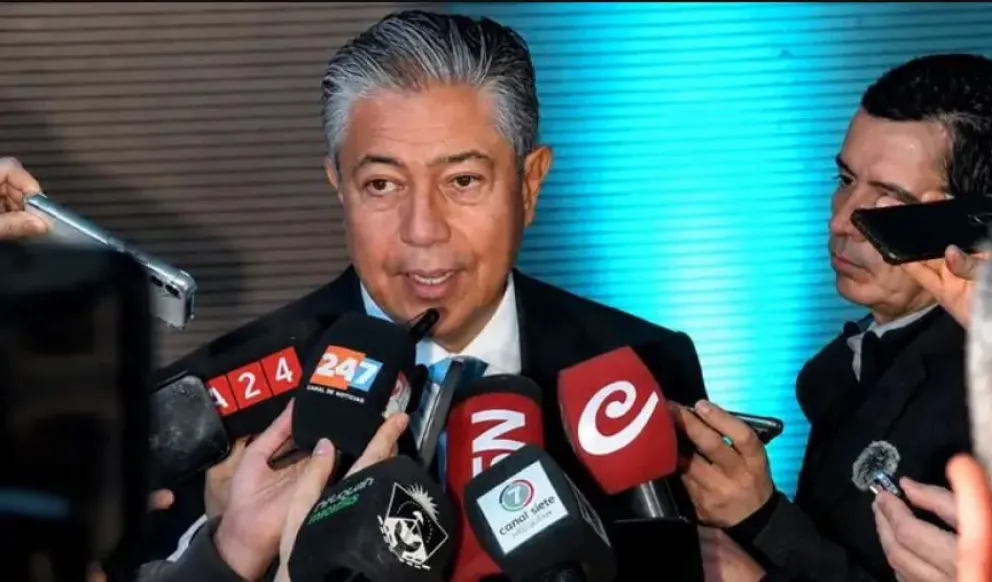
Governor Rolando Figueroa confirmed that the Executive Branch of Neuquén will not intervene in judicial decisions regarding evictions related to property disputes between private individuals. He made the statement during Neuquén Day, held in the City of Buenos Aires, when he was asked about the recent eviction of Lof Kinxikew in Villa La Angostura. The phrase used by the governor was that these are matters between private parties.
The position is not new. On July 23, Figueroa had argued that, except in the case of Camping Correntoso, the evictions ordered in Villa La Angostura corresponded to private disputes and that the Executive could not intervene in judicial rulings. The repetition establishes an institutional criterion of separation of powers, but it does not resolve the debate about the administrative obligations that may exist around indigenous communities, social assistance, or political mediation.
The lonco Manky Kinxikew traveled to the meeting to request a direct conversation with the governor. According to her account, she was unable to hold that meeting and had a brief exchange with the national senator Julieta Corroza, who referred her to the Minister of Government, Jorge Tobares. The community leader stated that she will continue making the complaint visible and questioned the provincial administration for limiting itself to describing the case as a private controversy. Her demand combines the immediate territorial situation with a request for a stable political channel to address similar conflicts.
The Mapuche community and organizations invoke the provincial Constitution, the Convenio 169 of the International Labour Organization, and the Ley provincial 3.401 to demand state intervention. That position maintains that the conflict cannot be analyzed solely as a property dispute. The note released does not include the full text of the court order, the disputed titles, or the proceedings of the file, so it does not allow establishing the legal scope of each argument.
An official source offered an additional reconstruction of the episode. It pointed out that the press conference had an order of questions, that the man who persistently approached Figueroa would not have arrived with the community, and that its members said they did not know him. This version does not change the content of the governor's response, but provides context about the exchange. It also stated that community representatives spoke afterwards with the Chief of Staff. The identity or behavior of the person who asked the question does not resolve, in any case, the substantive issue raised by the Lof.
According to that same official explanation, the subsequent dialogue would have allowed for the coordination of a formal meeting in the coming days. Until the meeting has a confirmed date, participants, and agenda, it should be presented as an arrangement in progress and not as an already established table. An institutional instance could address assistance, mediation, and compliance with regulations without the Executive replacing the court in charge of the property file.
The conflict presents two perspectives: that of the Government, which emphasizes the private nature and judicial independence, and that of the community, which demands specific public obligations towards indigenous peoples. There is no agreed solution or review of the eviction in the statements. The next verifiable step will be to see whether the announced meeting takes place and what administrative actions the Province can take within its powers, keeping judicial decisions and political responsibility separate. It will also be necessary for the parties to publish basic information about the file to prevent the debate from being reduced to slogans that are incompatible and partial versions. The presence of observers and a record of the meeting could provide continuity to the dialogue. Any administrative agreement must respect the current judicial ruling, unless it is modified through the corresponding procedural channels. Transparency will help reduce new confrontations in the territory.