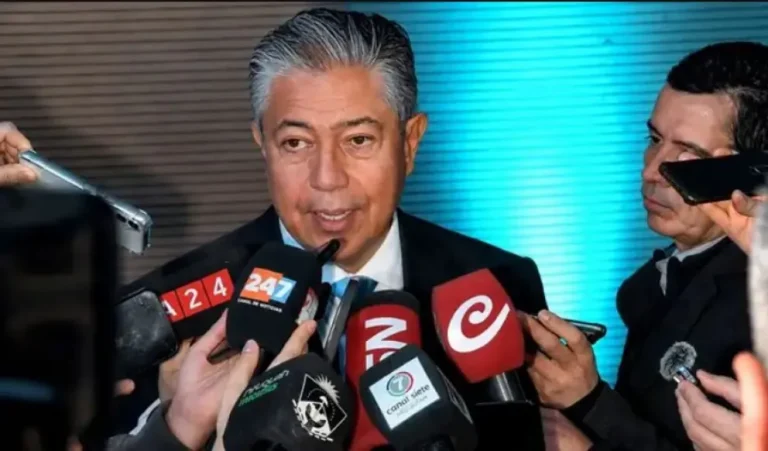
The decision of the mayor of La Banda, Roger Nediani, to confirm 214 agents in the permanent staff sparked a controversy during the municipal transition. The Decreto Serie A N°227/2026 was dated August 18, 16 days after the August 2 election in which Llamil Abdala was elected as the next communal chief. The temporal proximity raises political questions, but does not in itself prove the illegality of each incorporation.
The passes have administrative effects that will continue during the next management period. To determine their regularity, the seniority and previous employment modality of the workers, the applicable competitions or requirements, the existence of vacancies, the assigned category, and the budgetary backing must be verified. The 214 agents were already providing services and being paid as temporary or contracted workers, so it is not appropriate to automatically calculate 214 completely new salaries. The future cost, stability, and job structure can, however, change. It must also be checked whether everyone received equal treatment compared to other employees with comparable functions and seniority.
The debate intensified over the composition of the 2026 municipal budget. The personnel item amounts to ARS 46.623.402.443,31 out of total expenditures of ARS 64.278.964.869,44, equivalent to 72,53%. Article 110 of the Carta Orgánica establishes that no more than 60% of the revenues can be allocated to salary payments. The budgeted difference is 12,53 points and is around ARS 8.056 million compared to the mathematical 60% of that total.
That comparison is a signal that demands explanation, not a definitive legal conclusion. The authorized budget is not identical to the executed expenditure, nor does the total disbursement necessarily match the revenue base that should be applied according to the regulation. To prove noncompliance, the resources actually received and the salaries actually paid during the fiscal year must be known, in addition to opinions from Accounting, Economics, Legal Affairs, and the Tribunal de Cuentas.
The controversy is compounded by opposition complaints about more than 700 hires following cost-containment measures adopted in 2023, in addition to reclassifications, bonuses, and relatives or candidates in municipal positions. These claims need to be cross-checked with payrolls and personnel files. The sets cannot be added automatically, either, because a person could appear among the complained contracts, the promotions, and the 214 recent transfers.
The existence of kinship or electoral participation does not by itself prove any irregularity. What is relevant is to establish when each person joined, what role they fulfill, how they were appointed, what remuneration they receive, and whether they obtained a benefit different from that of workers in equivalent conditions. The review must protect the rights of employees with years of service and, at the same time, detect any selective decisions motivated by political or family ties. Publishing functional data and administrative acts, while preserving sensitive personal information, would allow monitoring of the procedure without collectively stigmatizing the municipal workforce.
The next administration will need a documented audit of vacancies, personnel files, payroll, contracts, and budget execution. So far, neither a ruling nor a definitive opinion invalidating the decree has been reported. The confirmed fact is the formalization of 214 workers in a transition phase; the pending questions are their cost, procedure, and compatibility with Carta Orgánica. Resolving them requires complete files, not general condemnations or political defenses without data. The transition should include a technical table between outgoing and incoming authorities to deliver payrolls, annualized calculations, and observations from the control bodies. The result would have to be published with a methodology that allows the calculations to be reproduced and any errors to be corrected. The affected workers must also be able to exercise their right to defense. Institutional trust depends on that transparency.