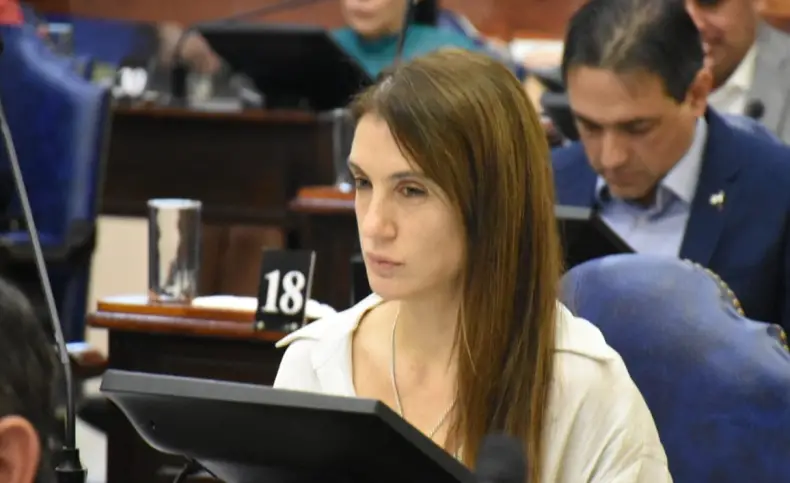
Notebooks attributed to fourth-grade students sparked a controversy about the boundaries between teaching provincial history and promoting a government in office. The records present 1995, the year in which Gildo Insfrán assumed the Governorship, as the beginning of a transformation of Formosa associated with improvements in life, work, and values. Radical deputy Agostina Villaggi took the case to the Ministerio de Capital Humano of the Nation.
Villaggi identified Colegio Don Bosco and stated that she had received materials from other schools in the provincial capital. According to her complaint, nine- and ten-year-old children copied in Social Studies content favorable to the so-called Modelo Formoseño, with references to solidarity, cooperation, and effort. The legislator particularly questioned that Insfrán's rise to power appears alongside events such as the founding of the city and provincialization, under the idea of a third founding.
The political presentation alone does not demonstrate that the activity is repeated throughout the system or that there is a written instruction from the governor. To determine its scope, the plans, manuals, full instructions, and testimonies of the educational authorities must be included in the file. This verification will allow distinguishing between a specific proposal from a teacher, an institutional adaptation, and a general directive for primary schools.
Lucy Aguayo, a teacher and former member of Junta de Clasificación at the primary level, warned that the curriculum design does not require teaching a government project and that a partisan orientation could violate the provincial Constitution. At the same time, she avoided generalizing based on the images circulated. Her argument separates legitimate teaching of recent transformations from a one-sided assessment of the administration, a distinction that will need to be examined using the complete materials.
The provincial Ministry decided to defend the content. The Director of Primary Education, Juan Ignacio Meza, stated that studying territorial, economic, and social changes does not constitute a slogan, but rather a teaching supported by the Constitution of Formosa, Consejo Federal de Educación, and the curriculum design. He included in that approach infrastructure works, productive development, the health system, and the socioeconomic foundations, and considered that removing it would be equivalent to censoring local identity and memory.
The official response confirms that the authorities did not treat the material as an anomaly that should be removed immediately, but it also does not resolve the accusation regarding its orientation. The next step will be the response from Human Capital and the publication of the teaching sequence, its objectives, texts, evaluation criteria, and territorial scope. Until then, the indoctrination will remain a complaint attributed to Villaggi; the verifiable fact is the institutional defense of content linked to Insfrán's political model.