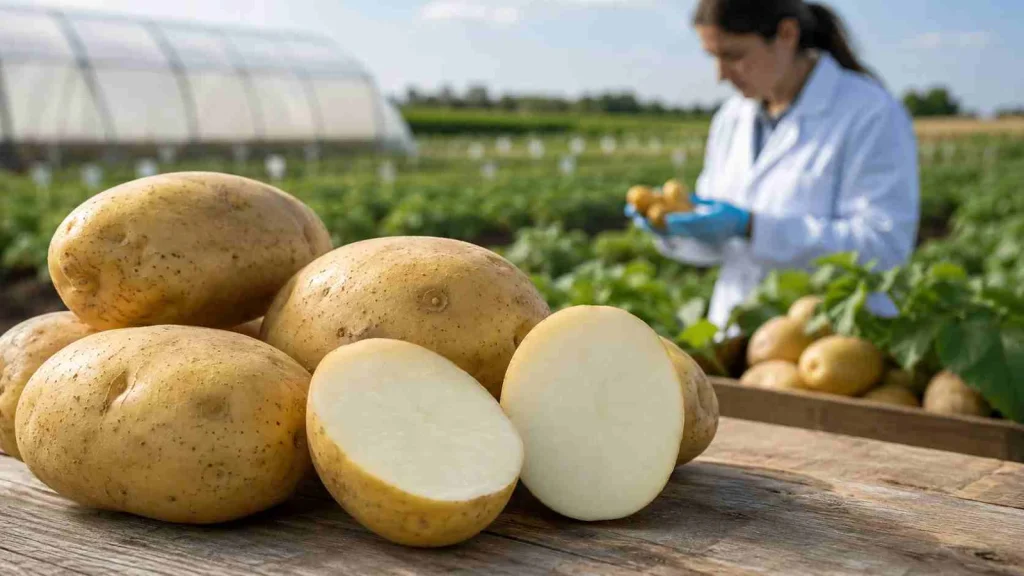
INTA Balcarce developed OLI INTA, presented as the first gene-edited potato variety in Argentina. The innovation seeks to prevent enzymatic browning that appears after bruises, cuts, or damage during handling. By reducing these visible and internal spots, the development aims to decrease commercial losses and waste in production, industry, and consumption.
The change was obtained by deactivating the gene that produces the enzyme polyphenol oxidase. This enzyme is involved in the reaction that darkens the tissue when the potato is damaged and comes into contact with oxygen. The tests carried out showed the absence of sub-surface bruising, a relevant characteristic because deterioration can go unnoticed until the tuber is cut or processed.
Researcher Gabriela Massa explained that the variety does not incorporate DNA from other species and, for that reason, is not considered transgenic. The material is subject to the same rules as cultivars obtained through conventional breeding. The difference lies in the precision of the tool, which allows intervention on a defined trait without introducing an external gene.
Sergio Feingold highlighted that gene editing can accelerate breeding programs and facilitate adaptation to new production or market demands. In this case, the improvement is linked to post-harvest quality and the use of the raw material. The expected benefit will now need to be verified at a commercial scale and across different links of the chain.
OLI INTA has already been incorporated into the National Registry of Cultivars and the National Registry of Plant Breeders' Rights of INASE. The work was a joint effort between INTA and CONICET, with participation from Universidad Nacional de Mar del Plata and funding from Procisur and Fontagro. These steps provide institutional and registry support to the development carried out in Balcarce.
The project also includes the possibility of managing records in Brasil, while Unión Europea advances in a framework for new genomic techniques. However, those extensions still depend on regulatory decisions and procedures specific to each jurisdiction. The confirmed novelty is the Argentine registration of a potato edited to resist browning; its adoption, scale, and economic impact remain open.