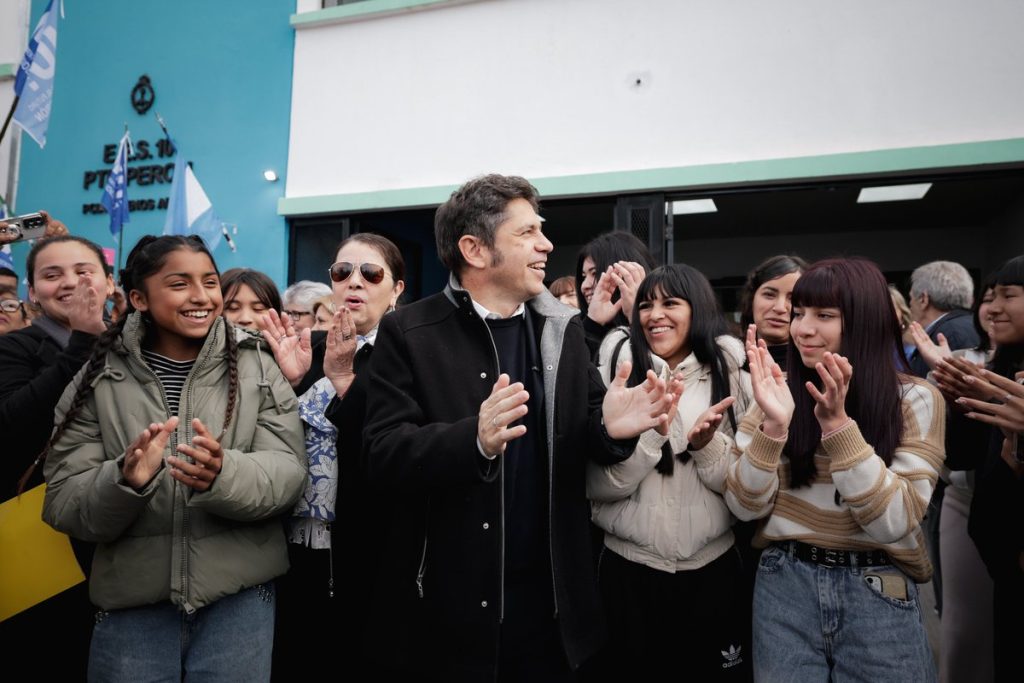
Governor Axel Kicillof formally inaugurated the new buildings of secondary schools No. 5 and No. 10 in the Buenos Aires municipality of Presidente Perón. He was accompanied by the General Director of Culture and Education, Flavia Terigi; Mayor Blanca Cantero; provincial authorities; and the principals of both establishments. The event took place in Guernica and combined the opening of educational infrastructure with the presentation of other renovated public facilities in the district.
The informed investment for the two schools reached ARS 6.404 million and was funded by Banco de Desarrollo de América Latina y el Caribe, CAF. The buildings are intended for more than 1.100 students from the San Pablo and Parque Americano neighborhoods. Escuela Secundaria N°5 has 12 classrooms, an auditorium, a library, a computer workshop, and a kitchen; No. 10 adds nine classrooms and complementary spaces for school activities.
The Buenos Aires administration indicated that the facilities include laboratories, libraries, teacher lounges, multipurpose rooms, courtyards, and service areas, although the specific distribution varies between establishments. The immediate goal is to replace or expand previous classroom conditions and absorb the demand from an area experiencing population growth. The inauguration allows the use of the buildings, but their impact should be measured by actual enrollment, maintenance, equipment, teaching coverage, and pedagogical continuity. It will also be relevant to know whether the new capacity reduces commutes to other neighborhoods, improves the school day, and allows the continuation of scientific, technological, and community activities that previously lacked adequate spaces.
Kicillof framed the works within a provincial program that, according to the figures presented during the event, accumulates 321 new school buildings, 500 completely rebuilt establishments, and more than 1.300 classrooms created through expansions. These data correspond to the balance presented by the provincial Executive and were not accompanied in the communication by a comparative series of investment, deadlines, or budget execution of each project. The announced scale should be compared with consolidated administrative records.
The governor defended the role of the State in the face of the growth of Presidente Perón and stated that schools, health centers, police stations, and public spaces require coordinated investment between the Province and the municipality. Terigi linked the openings with the expansion of Buenos Aires' educational infrastructure, while Cantero pointed out that the works allow for studying within one's own community. The interventions also functioned as a political critique of the national adjustment and as a vindication of the provincial model of public spending.
The agenda included a tour of the new offices of Registro Provincial de las Personas and the sub-delegation of the Ministry of Labor, installed in a refurbished building. Kicillof also inaugurated the local Centro de Operaciones y Monitoreo. The official information did not detail in the same publication the consolidated cost of those three interventions or operational indicators of the security center, so they must be differentiated from the ARS 6.404 million specifically attributed to the schools.
The verifiable result of the day is the incorporation of two educational campuses and the recovery of state offices in Presidente Perón. The political discussion goes beyond these openings: it confronts a vision that presents public works as social investment with another that prioritizes spending reduction. To evaluate the performance of the program it will be necessary to observe the occupancy of the buildings, their maintenance, and the educational resources available, not just the number of accumulated inaugurations. The periodic publication of enrollment, maintenance costs, and results of each institution would allow a ribbon-cutting ceremony to become a policy subject to citizen monitoring and territorial comparison. This way it will be possible to know whether the investment effectively expanded the right to study near home and in better conditions.