The expansion of mining projects in San Juan has opened a dispute over who gains access to the jobs created by the industry. SOMPRA, a heavy-machinery operators' union still being formed, and the civil association AOMPE say more than 400 workers from San Juan remain unemployed while companies hire personnel from other provinces. The organizations maintain that the local roster has training and experience applicable to both mining and construction.
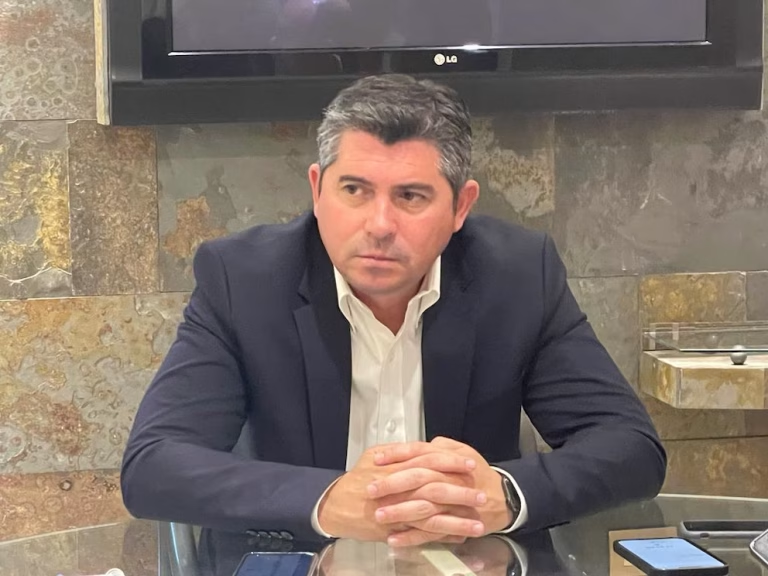
The demand covers trades essential to moving materials and preparing mining sites: operators of bulldozers, loaders, excavators, trucks and drilling equipment. Alejandro Campusano represents SOMPRA nationally, while Hernán Molina chairs AOMPE in San Juan. The association already has legal status, whereas the union expects to obtain national registration this year after nearly a decade of applications.
The organizations have tried to establish a direct channel with mining companies. Campusano said they sent letters to about 45 firms linked to Vicuña, Gualcamayo, Veladero, Josemaría and other projects, but only Los Azules answered the request for a meeting. They also approached municipalities: Iglesia replied, Valle Fértil is considering a training agreement that has not yet been completed, and neither Calingasta nor Jáchal, two departments central to provincial mining, sent a formal response.
The frustration goes beyond the absence of meetings. The leaders question the hiring of workers arriving from other districts when a San Juan labor pool is available. Molina described the case of a member who had to find work in La Pampa, where he waits two months to return home and pays for the tickets himself. For the organizations, that situation shows the distance between the industry's growth and its actual conversion into local opportunities.
Relations with the state have produced mixed results. Campusano recalled that under the previous Mining Ministry administration, the group asked for job opportunities and received ten helmets and a board, a response he considered insulting because the request was not for money but for dialogue. The meeting with current minister Juan Pablo Perea was more productive, although the operators say it has not yet led to concrete hiring.
The new local mining development law placed one instrument at the center of the debate: a floor of 80% San Juan labor on projects. SOMPRA and AOMPE believe the rule could reverse exclusion, but they want to know which agency will verify compliance and how it will be applied. Their demand is no longer merely to be heard; it is for the quota to become verifiable hiring within an industry undergoing expansion.
Training presents another constraint. AOMPE said renting machinery for practical instruction costs six million pesos and that a course for ten candidates, at 70,000 pesos per person, barely covers operations; even so, it trained 22 operators in one month through safety and hygiene theory and practice on real equipment. For now, the leaders are maintaining letters and dialogue, although they warned they may change strategy without answers. The next steps are SOMPRA's national registration and, above all, effective enforcement of the local quota.