
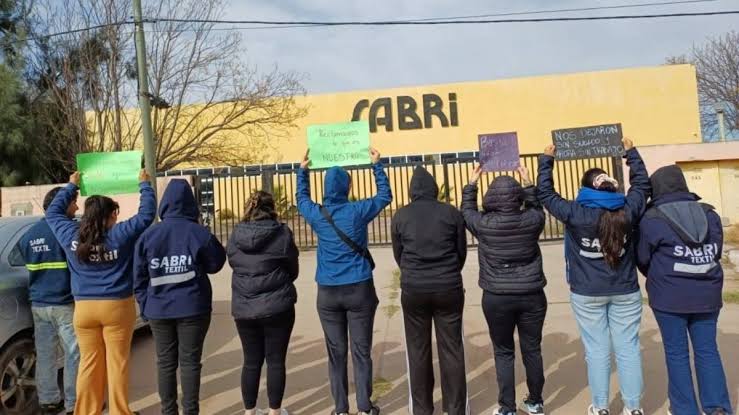
The textile company Sabri laid off 80 workers from its plant in Recreo, Catamarca, amid a reorganization that severely reduced its operational capacity. The company confirmed the layoffs but stated that it did not make the decision to permanently close the factory. That clarification is central: the case describes a large-scale labor and industrial contraction, not the total legal or productive cessation of the company.
The workers reported that they received the notifications via WhatsApp messages and questioned the fact that a formal procedure had not been used. Their legal representatives argued that this method could affect the fulfillment of obligations arising from the dismissal. They also pointed out alleged salary delays, poor working conditions, and production demands that would have worsened over the months. These are claims from the workers and will still need to be examined in the relevant administrative or judicial instances.
Sabri was founded in 1984 and produces clothing for international brands such as Zara and Puma. In its busiest years, it reached more than 350 employees and became one of the main private employers in Recreo. The information released after the adjustment indicates that the plant had decreased to around 140 workers and would remain with approximately 30 active employees. That sequence reveals that the current 80 layoffs are part of a previous and longer reduction. The difference between the reported allocations also requires reconstructing previous departures, retirements, and contracts that had already ended before this episode.
The company described the decision as a painful business measure aimed at reorganizing the operation. Among the factors mentioned were the drop in domestic consumption, the growth of imports, the disappearance of national yarn suppliers, and payment terms of between 30 and 90 days imposed by large retail chains. These explanations belong to the board and do not replace an audited balance sheet on sales, costs, orders, inventories, and debt. It is also still unknown whether the client brands reduced orders, changed suppliers, or renegotiated conditions during the crisis.
The conflict entered an institutional stage because the dismissed employees are awaiting a conciliation hearing called by Ministerio de Trabajo de Catamarca. There it must be determined whether there is room for reinstatements, severance agreements, or changes in the reorganization. The call does not annul the layoffs nor guarantee a solution. Its function is to open a negotiation instance and formally establish the positions of the company, the workers, and the labor authority.
The impact goes beyond the factory. Recreo has an economic structure in which each industrial establishment concentrates employment, local consumption, and demand for services. A reduction of around 80 jobs affects family income as well as businesses, transportation, and suppliers. At the same time, the remaining 30 workers indicate that there is residual activity whose scale, orders, and outlook were not detailed. Formal continuity alone does not equate to long-term viability. For the province, maintaining that productive base is important because the sewing skills accumulated are not quickly replaced if the workers migrate to other activities or localities.
The monitoring must separate four facts: the layoffs already communicated, the complaints about their manner, the pending hearing, and the company's denial of a closure. To understand the actual trajectory, data will be needed on the effective workforce, monthly production, client contracts, wages owed, and severance payments. It must also be confirmed whether the plant continues to operate after the conciliation and at what volume. Presenting Sabri as closed would be incorrect; minimizing a reduction from more than 350 historical workers to about thirty active ones would also be incorrect. The economic signal is the accelerated loss of capacity in a flagship industry of the Catamarca interior.


