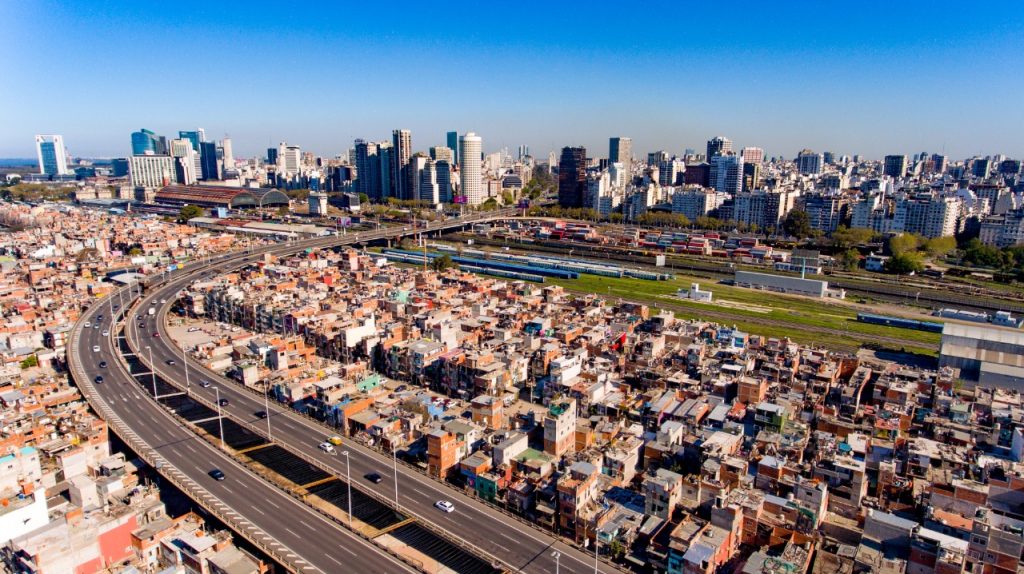
A survey by Fundación Tejido Urbano exposed the extent and diversity of the housing deficit in the slums and popular neighborhoods of the City of Buenos Aires. The study, built with data from the 2022 Census and the Encuesta Permanente de Hogares of INDEC, covered 15 complexes that encompass 98% of the households in that universe, about 200,000 inhabitants. Of the 56,667 households analyzed, 89% present at least one housing, services, overcrowding, or property regularity problem.
Material quality constitutes a relevant part, but it does not explain the situation on its own. 62% live in constructions considered deficient, 5.5% suffer from critical overcrowding —more than three people per room— and another 23.4% face moderate overcrowding. The report also identified 9,834 households, equivalent to 19% of the total, that need an additional dwelling: 5,366 occupy irrecoverable units, 2,435 are overcrowded, and 1,088 share a house with another household.
The services show a formally high coverage that hides precarious connections. Tap water reaches 88.3% and sewerage 95.1%, although a significant part of those accesses lacks regularity and does not guarantee the same quality or safety. The most marked gap appears in energy for cooking: 79.2% do not have piped gas or electricity for this purpose and mainly depend on gas cylinders.
The largest group does not necessarily require a new house, but rather to improve or regularize the one they already occupy. There are 33,956 families, among them 25,050 who live in units without material deficiencies but do not have legal security regarding tenure. Another 8,906 combine this tenure fragility with building or service problems. To this scenario, 6,681 tenant households are added, who do not present the previous deficits, but also cannot access ownership.
Housing inequality is connected with income inequality. 79% of households in these neighborhoods are below the total expenditure basket, compared to 21% of the Buenos Aires average, and more than half of the overcrowded families earn less than 886,000 pesos per month. Although these neighborhoods represent only 4% of the households in the City, they account for 54% of the needs for improvement of recoverable housing and 37% of the cases lacking basic services or secure tenure.
The diagnosis also prevents treating all neighborhoods as a uniform block. The five most populous account for 75% of their inhabitants, but Villa 31 and 31 bis show progress associated with urbanization, while Villa 21-24 maintains more severe environmental risks. The existence of 11% without individual problems and the weight of irregular land ownership indicate that the response cannot be limited to construction: it will have to combine new housing, improvements, regularization of services, and titles according to the specific needs of each household.