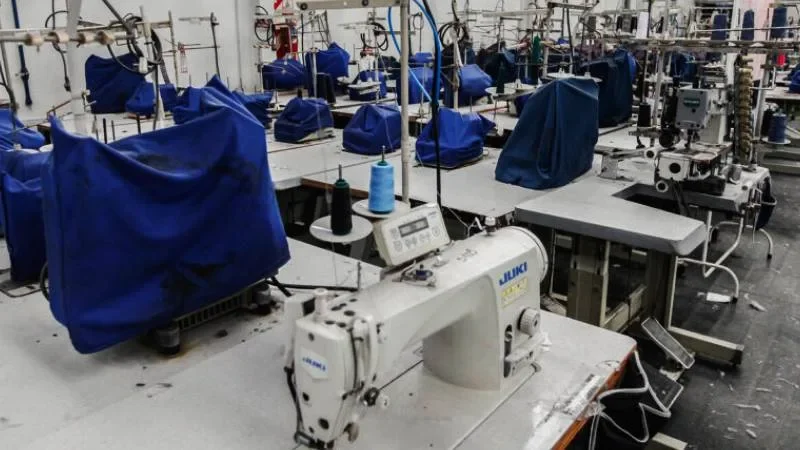
Chilcal keeps its production halted at La Rioja and has moved forward the vacations of its 120 workers while waiting for an extension of a tender to make uniforms for Policía de Santa Fe. The potential contract would allow activity to resume for approximately two months. The measure expresses a critical situation, but it does not equate to a definitive closure: the immediate continuity depends on a public order capable of temporarily sustaining the plant being finalized.
The company stopped manufacturing the traditional Far West jeans and reduced the production of work clothes due to a lack of orders. A month earlier, it had recorded some 20 lows distributed among its facilities in Capital, Chilecito, and Chepes. The clothing industry leader Gustavo Castro explained that jobs previously considered small are now accepted to retain employment. This adaptation shows idle capacity seeking any available volume, not a consolidated recovery of demand.
The case is part of a broader deterioration of the provincial manufacturing sector. Castro stated that eight textile companies left La Rioja over the past two years. Among the background information is Textilcom, which closed in 2024 and eliminated around 140 jobs, in addition to layoffs or suspensions in AlpaCladd, ENOD, and other plants of Parque Industrial. The situations are not legally the same: a provincial exit, a closure, a suspension, and a staff reduction describe different degrees of contraction.
The SIPA records cited to size the labor market show that La Rioja went from around 30.000 formal private employees in December 2023 to 27.400 a year later. The loss of 2.600 jobs represented a year-on-year drop of 8,6%, the steepest among the provinces for that period. The data is prior to the current stoppage of Chilcal and cannot be attributed solely to the textile industry, but it reveals the limited absorption margin available.
Vulnerability has its roots in a productive structure developed around the industrial promotion of Ley 22.021. Textiles, clothing, and footwear retained a decisive weight, although they depend on the domestic market, tax benefits, and government purchases. To this picture was added the increase in imports: during the first quarter of 2025 they grew by 87% in volume for textiles and 86% for garments compared to the same period of 2024. In January of 2025, national employment in textiles, clothing, leather, and footwear accumulated a year-on-year decline of 6,7%.
The contraction of construction due to the halt of public works reduced another avenue of reintegration for industrial workers. There is also uncertainty in rural employment: delegates of UATRE reported national delays in ratifying wage agreements for the olive, pig, irrigation, and general labor activities. These are different conflicts, but they converge in a province where the private sector is small and every loss of income is transmitted to commerce and family consumption.
A tender can provide oxygen, although it does not replace a diversification and competitiveness strategy. To assess the outcome of Chilcal, the award, the contracted volume, the restart date, the effective duration, and the evolution of its workforce must be known. It will also be necessary to observe whether the workers receive full wages and contributions during the early vacations, and whether the previous 20 layoffs resulted in a smaller workforce. This monitoring must include the three plants involved. The monthly update of personnel and production will allow verification of whether the pause is reversed. Presenting the plant as closed would be incorrect; ignoring its dependence on an order for two months would be too. The structural signal is that a factory with 120 workers survives month to month while the province needs to generate alternatives capable of sustaining stable private employment.