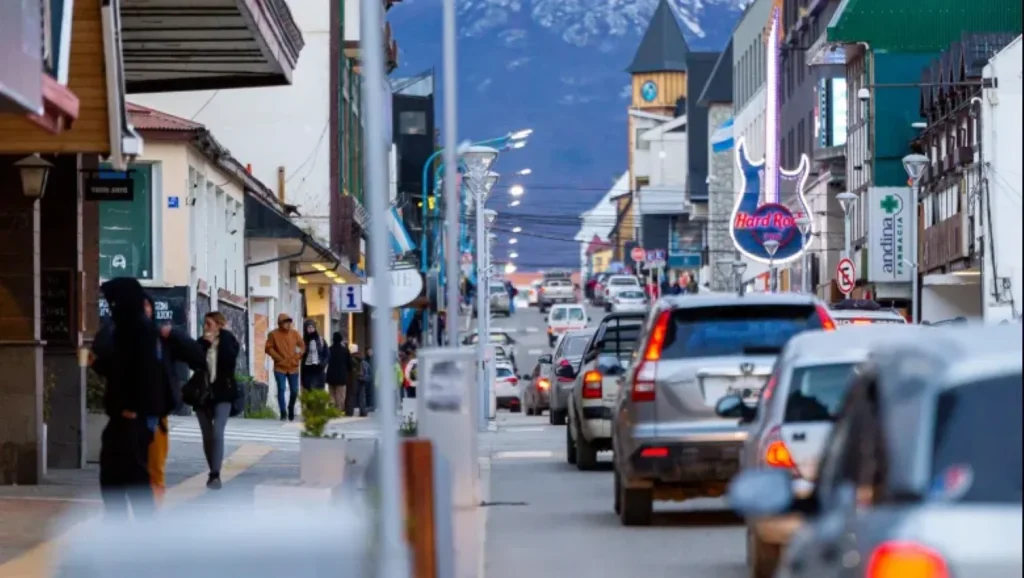
The trade of Ushuaia goes through store closures and a drop of more than 37% in supermarket sales. Claudia Fernández, vice president of Cámara de Comercio y otras Actividades Empresarias de Ushuaia and of CAME, linked the deterioration to lower cash flow, higher household debt, and increased job seeking. The information does not include a total count of closed businesses in the city.
Fernández noted that commercial closures extend beyond San Martín street and reach small and microenterprises, which are responsible for a central part of local private employment. She estimated that each closure affects two or three families and mentioned the number of resumes received as a sign of increased unemployment. That statement reflects the leader's assessment and not a labor statistic constructed from each establishment.
The lack of liquidity appears as the immediate mechanism of contraction. According to the business representative, Tierra del Fuego shows high levels of indebtedness and delinquency on credit cards, so part of the available cash is allocated to paying off previous obligations. Purchasing food in installments summarizes to what extent households have shifted everyday expenses to credit.
Consumption did not disappear, but it changed channel and scale. While large retail outlets recorded a marked contraction, neighborhood stores grew between 18% and 21%. Fernández explained that shoppers substitute the trip to the supermarket with small and frequent purchases near their homes. That increase does not compensate for the overall decline, because it responds to the fragmentation of spending and not necessarily to a greater volume of consumption.
The modification also alters the distribution of income among commercial formats. Neighborhood businesses receive daily operations of smaller amounts, while supermarkets and larger stores lose complete purchases. For SMEs, the challenge is to maintain employment and fixed expenses with less predictable billing. For families, the priority is to manage debt and cover immediate needs with the available cash.
Fernández expressed a moderate expectation, although without identifying a recovery already underway. The next sign will be to verify whether the movement in stores is sustained, whether delinquency decreases, and whether closures and job applications stop accumulating. As long as these variables do not change, the growth from 18% to 21% in neighborhood shops should be read along with the drop of more than 37% in supermarkets, not as a reversal of the crisis.