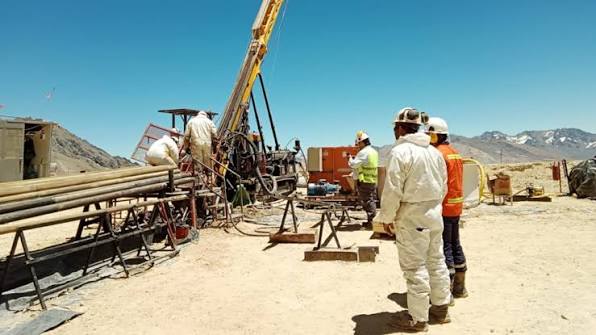
The second stage of Sal de Oro has received national approval to join Argentina's Large Investment Incentive Regime. The lithium project owned by South Korean company POSCO lies along the border between Salta and Catamarca and calls for US$547 million in direct investment. The technical decision allows work to proceed on an expansion intended to add industrial capacity where the company already operates.
The approved plan provides for facilities capable of producing 23,000 tonnes of lithium carbonate a year. That figure defines both the scale of the new phase and the product that will be added to the complex. The expansion is not presented as a separate development, but as a further section of Sal de Oro that extends processing of the mineral resources available across the area shared by the two provinces.
The commercial projection accompanies the increase in capacity. Once the new facilities reach full operation, the project expects exports worth more than US$300 million a year. Entry into RIGI therefore combines a quantified initial investment, an annual production target and an anticipated export flow—three benchmarks against which the commitments of the second stage can be measured.
The expansion will also change the composition of POSCO's output in Argentina. The company already produces lithium hydroxide in the country, and the new phase will add lithium carbonate. The national economy authorities described that combination as a diversification of the industrial chain: two different compounds produced within the same mining strategy instead of an operation concentrated on a single product.
Both materials are intended for the global market for batteries used in electric mobility. During the technical assessment, the compounds were described as high-value-added inputs with the capacity to generate foreign currency. The significance of the approval therefore lies not only in the volume of mineral to be processed, but also in adding an industrial product aimed at a specific international demand.
With approval under the regime now secured, the next step is to build the facilities covered by the US$547 million investment and bring them to the planned capacity of 23,000 tonnes a year. The expansion's performance can be assessed once the plant reaches full operation and exports approach the announced threshold of more than US$300 million annually. Until then, those figures remain the project's approved technical and commercial targets.