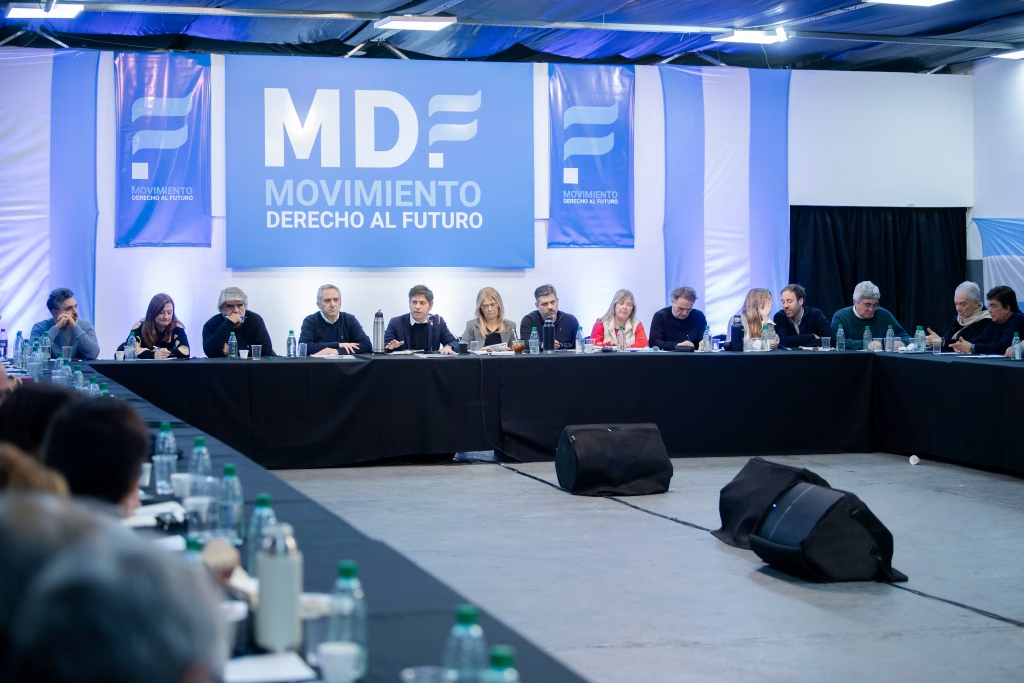
Axel Kicillof summoned mayors and officials from Movimiento Derecho al Futuro to La Plata to organize a political project that is no longer confined to Buenos Aires provincial government. The 4:30 p.m. meeting is intended to review the situation after recent Peronist moves, establish territorial priorities and define how the governor's space will reach 2027 with its own structure, electoral capacity and a recognizable national strategy.
The meeting follows Máximo Kirchner's rally in Lanús and talks involving Kicillof, Sergio Massa and other PJ leaders over the 2027 budget and the continuity of PASO primaries. That sequence reflects the central tension: the governor takes part in broader negotiations to preserve a common front while accelerating a differentiated organization that competes for leadership, cadres and representation inside the same Peronist coalition.
Primaries appear as a possible arbitration mechanism. Different sectors believe PASO could organize presidential, provincial and legislative candidacies without allowing a single leadership to impose the result. The discussion, however, depends on the future of the national electoral system and on agreements within Peronism. For the MDF, defending primaries also preserves an institutional route for competing with Kirchnerism and the Frente Renovador.
The other immediate issue is municipal reelection in Buenos Aires Province. Kicillof and his main officials support changing the law limiting consecutive terms, but the reform needs votes in the legislature and does not command a uniform position within the governing alliance. For many mayors, the rule defines their personal future; for the governor, it also affects the stability of the territorial network supporting his project.
The MDF is also seeking to expand beyond the province. Kicillof plans a visit to Jujuy and new activities with leaders from other districts as part of an effort to present himself as an alternative to the federal government. The challenge is to prevent expansion from becoming a sequence of events or individual contacts: a presidential project requires local leaders, organization, a program and the ability to intervene in conflicts beyond Buenos Aires.
Kirchnerist critics question precisely that capacity for expansion. Figures from that camp portray the governor as confined to meetings with his own inner circle and contrast the pattern with Máximo Kirchner's federal contacts in San Juan, La Rioja, Entre Ríos and Chaco. The criticism suggests that the MDF speaks of openness while consolidating an internal core; Kicillof's implicit response is that an autonomous structure is necessary to negotiate without subordination.
Relations with the sector led by Cristina Kirchner are at a difficult point. La Cámpora leaders connect the deterioration with commitments they say were not fulfilled after the party congress, while Kicillof's circle tries to preserve dialogue without abandoning autonomy. The dispute is not merely personal: it concerns candidacies, control of the PJ, ties with mayors and who will represent Peronism against Javier Milei.
The meeting must produce more than a photograph of support. The MDF needs to assign responsibilities, set an expansion calendar, define positions on primaries and reelection, and establish a method for coexisting with other coalition partners. If those choices become organization, Kicillof will reach 2027 with greater bargaining power; if the project remains confined to Buenos Aires, its national claim will remain vulnerable to Kirchnerist criticism.