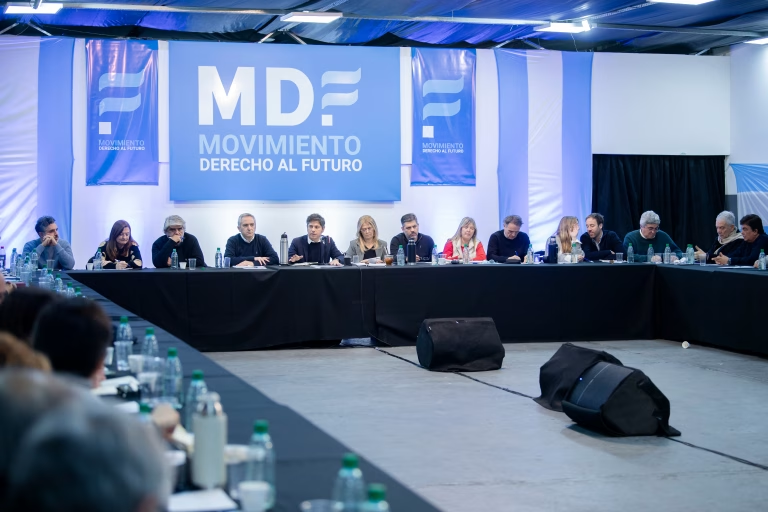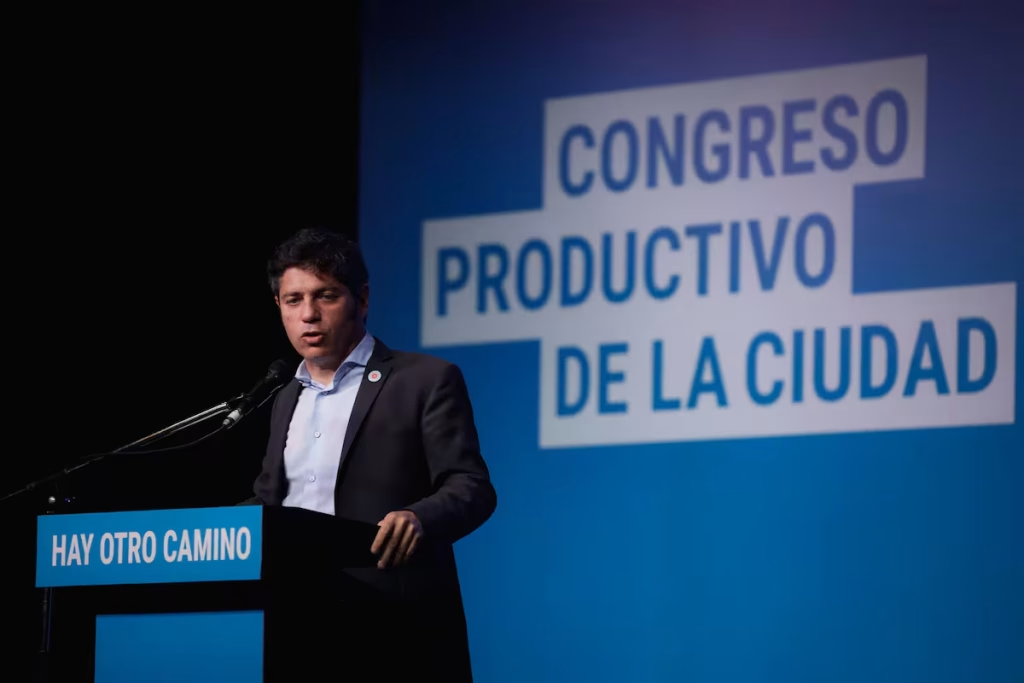
Axel Kicillof brought the Movimiento Derecho al Futuro into downtown Buenos Aires through a two-day Productive Congress combining economic debate, alliance-building and presidential projection. The second day took place at Teatro Astros before more than five hundred people, only hours after the governor joined another summit with Máximo Kirchner, Sergio Massa and Peronist governors. The sequence showed his national project advancing alongside unresolved negotiations within the party.
The event was organized by Buenos Aires Production Minister Augusto Costa, the MDF's main organizer in the capital. Initial panels at the National Technological University in Villa Ortúzar brought together businesspeople, researchers, unions, former officials and political leaders. The stated purpose was to draft a production and employment agenda, but the event also helped install Kicillof in a district where his movement has weak territorial roots.
In his speech, the governor said Javier Milei's model was exhausted and could not be replaced by cosmetic alternatives, an allusion to figures seeking distance from the President without abandoning his economic program. He described a catastrophe of formal job losses, business closures, falling wages, informality and decline in industry, construction and commerce. His argument connected social deterioration with a change in national economic direction.
Kicillof also rejected treating the capital as an isolated economy. He said between 47% and 51% of the city's value added is produced by workers who live outside the district and proposed linking companies with universities, science and technology. By describing Buenos Aires as a federal capital integrated with the country, he framed the local agenda as part of a national development project rather than only an electoral platform.
Attendance revealed contacts with different sectors. Hugo Yasky, Juan Manuel Abal Medina, Victoria Onetto, Berenice Iañez and Victoria Montenegro participated, as did Itai Hagman, who is close to Juan Grabois. Manuel Socías, Leandro Santoro and Matías Lammens, linked to Juan Manuel Olmos, also attended. Grabois had publicly endorsed Kicillof for president, while Olmos's group remained more cautious.
The most discussed absence was La Cámpora. No major figure from the organization attended despite Kicillof's recent gestures toward Cristina and Máximo Kirchner. That prevented a picture of unity and showed that leaders from different groups attended individually, not as part of a collective alignment behind the MDF. The congress broadened dialogue but did not settle the internal dispute.
At the close, Costa, Santoro and Lammens called for broad agreements to compete nationally and in the capital, where they anticipate convergence between La Libertad Avanza and the PRO. Some participants said candidacies should not yet be discussed and electoral negotiations could wait until March. That caution contrasted with chants of “Axel president” and the unmistakable presidential reading of the event.
The MDF's challenge is to turn the impact of one gathering into lasting organization. It needs neighborhood cadres, agreements with the city PJ and a specific platform on services, housing, work and production, rather than merely extending the Buenos Aires provincial government. The congress produced an agenda and initial network; the next test is whether partial support can become a stable, competitive coalition for 2027.