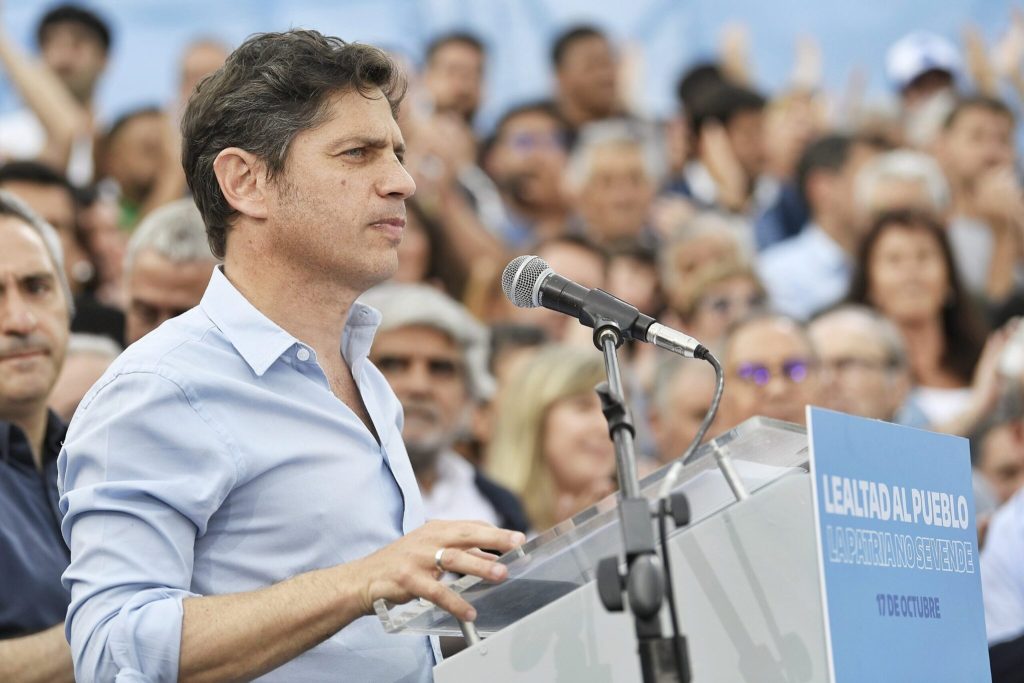
Axel Kicillof moved the dispute between Buenos Aires province and the presidential office onto electoral terrain. The governor accused Javier Milei of using federal resources as leverage over the provinces to obtain votes in Congress, particularly to suspend the Open, Simultaneous and Mandatory Primaries and clear the way for his reelection project. His argument combined an accusation about the government's negotiating method with an economic assessment of the libertarian administration's first 30 months.
Kicillof described that practice as a mechanism of “political blackmail and extortion” applied to all 24 jurisdictions. In his account, the federal government offers assistance with money it had previously stopped transferring to provincial administrations and turns financial need into a bargaining chip for legislative votes. The Buenos Aires governor said the pursuit of a second term guides the president's decisions and explains the pressure to eliminate an electoral stage the national ruling party wants to avoid.
The governor supported his criticism with figures he attributed to the federal government's economic performance. He said more than 300,000 jobs had been lost and 26,000 companies had closed while activity became concentrated in a small number of sectors. He also cited cumulative declines of 12% in industry, 5% in commerce and 15% in construction, together with an increase in household arrears that, in his assessment, exceeded the levels seen during the 2001 crisis.
The fiscal position of the provinces was at the core of the complaint. Kicillof calculated that since late 2023 the 24 jurisdictions had lost more than 47 trillion pesos in constant values. He presented that amount as equivalent to four percentage points of gross domestic product and a real cut of 13.4%, caused by lower federal revenue sharing, weaker provincial tax collection and reduced mandatory federal transfers.
With that diagnosis, the governor challenged the idea that the federal surplus could be separated from resources no longer reaching the districts. His objection was not limited to Buenos Aires: he argued that no province can solve a national crisis on its own and warned that extending the model through another term would deepen the productive and financial deterioration he described.
His conclusion was political. Kicillof called for a federal alternative capable of bringing the provinces together to confront the government's course and debate both resource distribution and electoral rules. The next point of tension will be Congress, where the government must seek votes to change the PASO system while governors decide how financial assistance and their outstanding claims affect that negotiation.