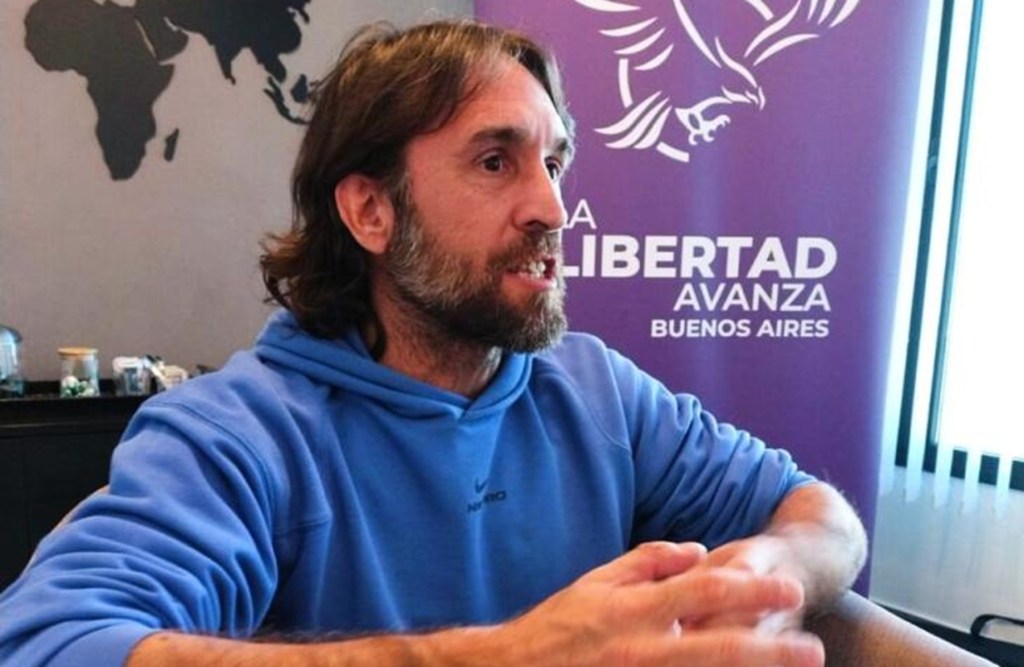
Oscar Ahumada has left La Libertad Avanza in Zárate, ending for now the project that had placed him among the possible mayoral candidates for 2027. The former River Plate footballer announced his departure after mounting differences with PRO Mayor Marcelo Matzkin and amid province-wide negotiations between the two parties. The resignation exposed the local cost of an alliance seeking to organise the governing coalition before the next election.
The dispute did not begin with an abstract ideological disagreement, but with day-to-day coexistence between the municipal government and the libertarian caucus in the city council. Matzkin's allies accused Ahumada of blocking executive initiatives and using his councillors to build a personal alternative. Each vote therefore became part of a struggle for leadership in a district governed by the PRO since 2023.
Ahumada had been recruited as a publicly recognised figure capable of competing for the mayor's office. His sporting career provided an entry point outside traditional politics, fitting the profile sought by the Buenos Aires structure led by Sebastián Pareja. That expectation, however, collided with a broader condition: the national government and the PRO are negotiating to avoid rival primaries or lists in municipalities already run by coalition partners.
He formalised his departure in a letter saying that he would continue political activity with independence and responsibility. Ahumada did not present the decision as a break with the national programme, but made clear that the party structure no longer offered room for his municipal project. The wording protected his political capital while avoiding a rhetorical rupture with the libertarian voters who had supported him.
The provincial LLA leadership offered a different interpretation. Its representatives said the resignation was unilateral and that Ahumada had been asked to build consensus with the local administration. They also accused him of placing an individual plan and personal grievances above the broader strategy. The response showed that the dispute was no longer private: the party chose to explain publicly why its prospective candidate had been removed.
Behind the conflict lies the agreement being promoted by Cristian Ritondo and libertarian negotiators for 2027. The head of the Buenos Aires PRO had already said that LLA would not field candidates against PRO mayors, a crucial guarantee for the twelve municipalities still controlled by his party. Zárate thus became a test case: protecting Matzkin required dismantling the candidacy of the person recruited to challenge for municipal power.
The resignation also joins other departures that reveal the difficulty of disciplining a young organisation while expanding through alliances. In La Matanza, councillor Leila Gianni had previously left after another internal conflict. The cases differ, but both expose a recurring tension between leaders who grew under the libertarian label and a leadership that now prioritises territorial deals, legislative discipline and coordination with established partners.
Ahumada must now decide whether to build a local party, join another force or remain independent. Matzkin received a favourable political signal, although he will still need council agreements to govern. The PRO-LLA alliance removed one electoral challenge in Zárate, but left an unresolved question: how many local leaders it is prepared to sacrifice in order to keep its Buenos Aires coalition together.