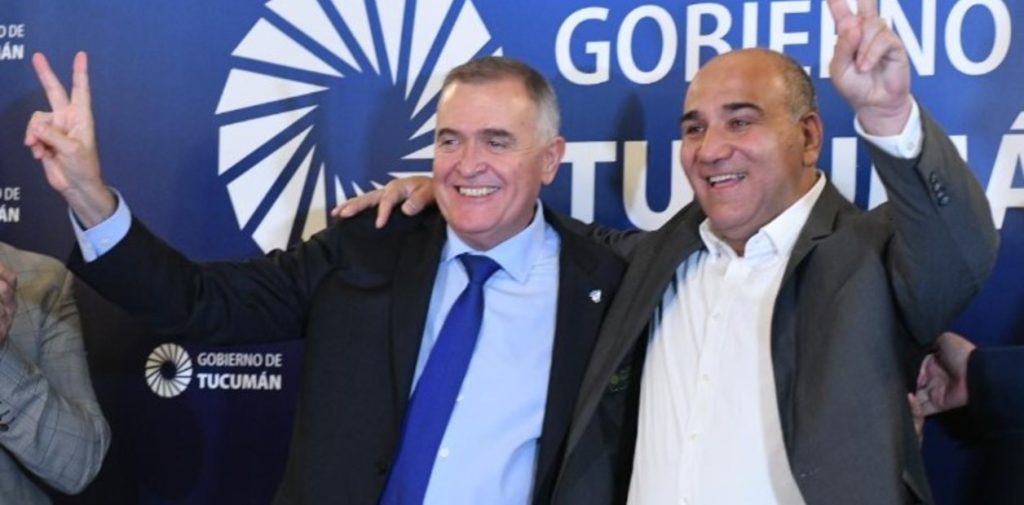
Osvaldo Jaldo challenged Juan Manzur to compete for the Governorship of Tucumán in the elections scheduled for May 9 2027. The governor stated that the provincial Peronism is aligned behind his leadership and demanded that the national senator publicly state whether he will be a candidate. The statement sets up a direct dispute, but Manzur has not yet made the formal launch that Jaldo demands from him.
The leader responded to rumors and criticisms coming from the environment of the former governor. He stated that Manzur lacks the decisiveness to announce his candidacy and used a derogatory expression to refer to leaders who speak on his behalf. The tone heightened internal confrontation and sought to put an end to speculation about a reconciliation or an agreement. The words belong to Jaldo and do not prove that all the mentioned sectors had set a candidacy or strategy.
Jaldo stated that the provincial ruling party is organized around his name, Vice Governor Miguel Acevedo, and Rossana Chahla in the mayor's office of San Miguel de Tucumán. That enumeration presents an electoral architecture from territorial power. However, the adhesion of the entirety of Justicialist Party, the integration of lists, and the formal selection mechanisms will have to be verified when candidacies are convened and made official.
Manzur governed Tucumán before Jaldo and currently holds a seat in the Senate. The possibility that he might try to return to the Executive circulates through tours and statements from close leaders, but the source does not record a personal confirmation. Therefore, talking about two officially confirmed candidates would exceed the available information. What is confirmed is Jaldo's willingness to compete and his public invitation for the former president to do the same.
The date of May 9 2027 was proposed by Jaldo as the day of the provincial election. Its realization will depend on the calendar and the corresponding electoral acts. The political announcement anticipates the competition, but does not replace the official call. It is also still unknown what the framework of alliances will be, the legislative and municipal candidacies, and whether the confrontation will be resolved within a primary or directly in the general election.
The challenge alters the internal balance because it forces Manzur's sector to choose between confirming, negotiating, or withdrawing the expectation. Jaldo tries to turn rumors into a binary alternative and display control over the officialist structure. That strategy can organize his followers, but also harden divisions before the closing of the lists. The verbal intensity does not allow predicting the outcome or measuring electoral support without surveys, endorsements, or registered candidacies.
The follow-up must verify three steps: formal call for the May 9, definition of Manzur, and officialization of the lists. It will also be necessary to observe whether the PJ agrees on internal rules or goes divided to the election. The senator's response can take different forms: launch, silence, negotiation, or support for another figure. None should be assumed before a verifiable statement. Likewise, Jaldo's statement about party alignment must be contrasted with decisions of bodies, mayors, legislators, and groups, not just with rhetorical endorsements. The eventual confrontation could also affect municipal and legislative candidacies, although the article does not provide names or agreements for those levels. The current news is the governor's challenge and his assertion of leadership, not an already constituted electoral duel. Maintaining the prospective condition prevents turning campaign statements into accomplished facts and allows each definition to be measured when it enters the institutional process. The rhetorical harshness marks a break in tone; the electoral break will depend on both spaces effectively competing and maintaining differentiated lists until the vote. Beforehand, mediations, unity agreements, or alternative candidacies not contemplated by the declaration may still arise.