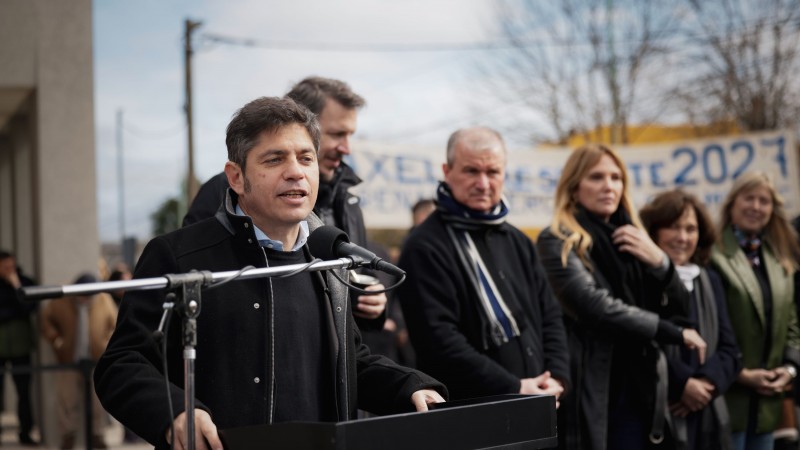
Axel Kicillof supported in San Miguel del Monte the March in defense of science, called by professionals, technicians, and fellows against the cuts applied by Gobierno nacional. The governor of Buenos Aires linked the demand to the need to keep in the country those who study and train, and criticized that the austerity pushes young researchers to seek opportunities abroad.
Kicillof recounted a conversation with Roberto Salvarezza, head of the Comisión de Investigaciones Científicas of the Province of Buenos Aires. He pointed out that the provincial system continues to finance projects, doctoral scholarships, and, within its means, new postdoctoral opportunities. His argument was that retaining scientific capacities requires a public intervention capable of sustaining training, research, and employment in the towns of Buenos Aires Province.
The statements were made during a management agenda in Monte. The governor formally inaugurated the new Provincial House along with Cristina Álvarez Rodríguez, Chief of Advisors, and José Castro, local mayor. The building required an investment of ARS 2,640 million and centralizes procedures and services of ARBA, IOMA, the Registro Provincial de las Personas, the IPS, several ministries, and a Provincia Net terminal.
The delegation also visited a water treatment plant and the enhancement of sewage treatment. Both projects required ARS 14,088 million. The first will provide arsenic-free drinking water to more than 15 thousand residents, while the second aims to increase the capacity for wastewater treatment. Kicillof presented these projects as a response to those who question the usefulness of the State.
The day included an agreement on the Loans to Municipalities line of Banco Provincia for infrastructure, services, and health strengthening. The president of the entity, Juan Cuattromo, participated. 53 Conectar Igualdad Bonaerense laptops were also delivered to students from four schools. Castro highlighted the cooperation between the municipality and the Province, even with party differences, due to the impact that the works have in a district with limited resources.
Kicillof also visited Petroquímica Argentina SA, which produces inputs for the food industry and is planning a new plant to expand capacity and employment. The agenda therefore brought together political support for the scientific community, inaugurations already completed, and projects still planned. Support for the march does not constitute a new national budgetary measure: it expresses the provincial position and is based on programs and works from Buenos Aires presented during the visit to Monte.