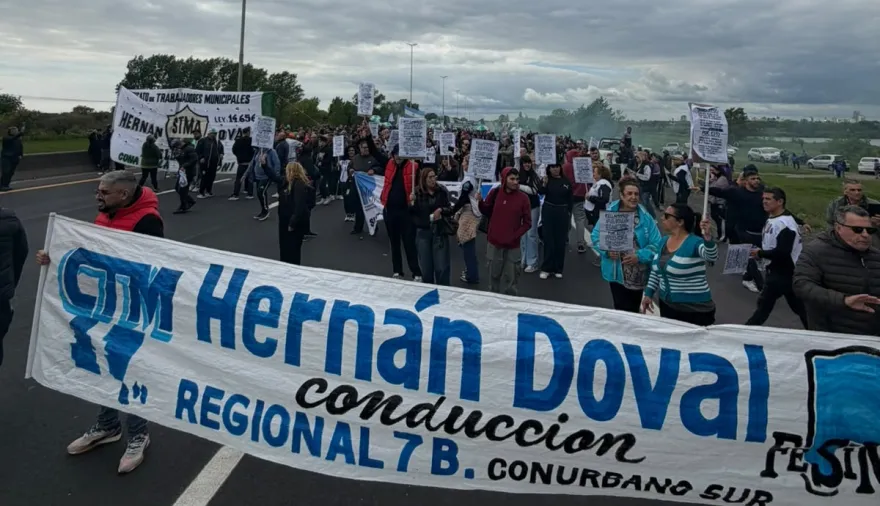
The Federation of Buenos Aires Municipal Workers' Unions deepened its protest plan by blocking the Buenos Aires-La Plata highway near Ezpeleta, in Quilmes. The action began as a partial interruption, then occupied both directions of the main roadway and lasted several hours. The escalation turned a sectoral claim into a metropolitan traffic problem and showed that union leaders are prepared to increase pressure on mayors and provincial authorities.
The protest was organized by the Southern Greater Buenos Aires regional group, which includes unions from Lanús, Almirante Brown, Avellaneda, Esteban Echeverría, Quilmes, Lomas de Zamora, Berazategui, Presidente Perón and Ezeiza. Fesimubo secretary general Hernán Doval attended. Although the formal call focused on union leadership, workers joined spontaneously, indicating discontent that extends beyond the organizations.
The blockade is part of a strategy the federation calls total, permanent and prolonged, but with gradual escalation. Three weeks earlier, the northern regional group had protested at the Panamericana highway and Route 197, initially occupying only the service road. At Ezpeleta, the lack of a continuous service road moved the action onto the main lanes. Some workers advocated even tougher measures, but the step-by-step approach prevailed.
The core of the dispute is wages. Fesimubo says almost all municipal employees earn less than the poverty line and that purchasing power has fallen by more than thirty percentage points since December 2023. Many workers must supplement income through delivery apps, odd jobs, small businesses or informal sales; when those options become saturated, more people rely on community and parish food kitchens.
The demand goes beyond take-home pay. The federation denounces underfunding of IOMA and the Provincial Social Security Institute, central pillars of health and retirement protection. It also demands the effective convening of the Municipal Employment Council, established by Law 14,656 to discuss labor conditions, categories, stability and collective policies. Delays reinforce the impression that problems are handled town by town without a provincial response.
Another critical issue is the growth of precarious hiring. According to the union, mayors increasingly use self-employed contractors and cooperative workers while delaying permanent appointments. These arrangements do not contribute to IOMA and IPS under the same conditions as stable staff, but to the national system administered by ARCA. The result is weaker worker protection, damage to provincial funds and a fragmented workforce.
The anger is not directed at a single political party. Union sources describe a conflict with mayors in general, with very few exceptions, and say partisan alignment has not changed wage erosion or precariousness. Leaders nevertheless want to leave room for local and provincial governments to react before adopting stronger actions. That gradual approach has a limit: the longer institutions delay, the more pressure comes from the rank and file.
The next stage depends on two concrete signals: an actual meeting of the Municipal Employment Council and wage proposals capable of restoring income rather than merely managing decline. Without them, Fesimubo promises further action in a plan that has already moved from service roads to main carriageways. Ezpeleta showed that the conflict is no longer a collection of local negotiations but a province-wide labor, pension and political dispute.