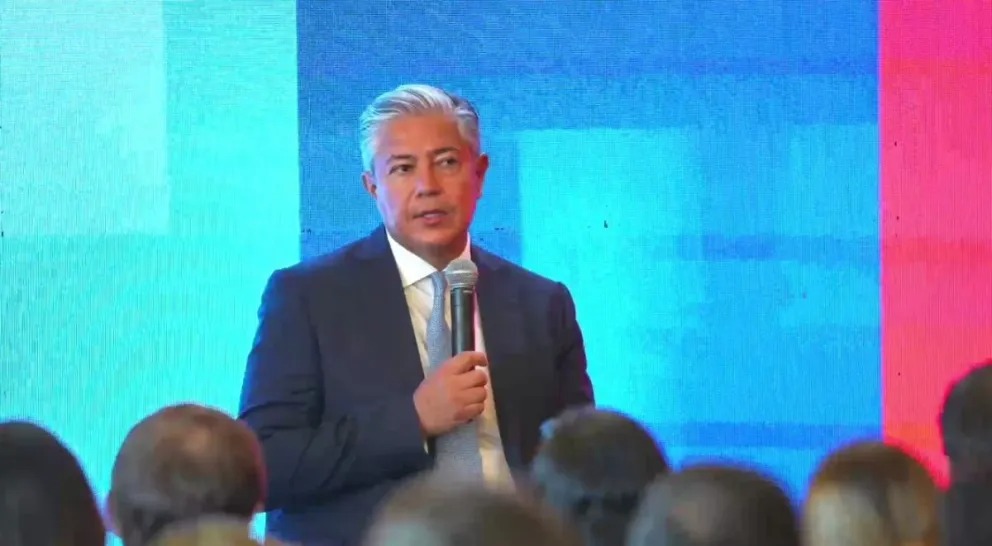
Rolando Figueroa will lead a mission of Neuquén to Washington and Houston to present Vaca Muerta opportunities and attract investment. The agenda combines diplomatic meetings, multilateral organizations, energy companies, and a sector forum. The trip is confirmed for this week, but merely holding meetings does not allow for counting new capital. Each investment must be accredited through agreements, amounts, timelines, and subsequent business decisions.
The first stage will be in Washington, where Figueroa will meet with the Argentine ambassador Alejandro Oxenford and participate in a breakfast with investors. The presence of Harold Hamm, founder and president of Continental Resources, a company that announced its arrival in Vaca Muerta, is expected. The participation of a prominent businessman improves the dialogue, although it does not by itself determine a volume of investment or an additional specific project.
The governor will also hold a meeting with Juan Pablo Segura, Under Secretary for Western Hemisphere Affairs of the State Department. In addition, he will meet with officials from Banco Interamericano de Desarrollo and Banco Mundial. The published agenda does not specify whether these multilateral meetings will review existing funding or explore new lines. Therefore, they should be presented as institutional contacts and not as granted credits.
In Houston, the company of a road financing agreement with YPF, Chevron, Pampa Energía, Pan American Energy, Phoenix Global Resources, Pluspetrol, Shell, Total Austral, Vista Energy, Geopark, and Harbour Energy is expected. The scheme includes paving the Ruta Provincial 8 between Ruta 6 and the Camino de Tortuga, as well as work on routes 6, 51, and 7. The company will be a verifiable step forward, but contributions by company, budget, schedule, contracting, and control must be known.
Figueroa will also participate in the fifth edition of Shale in Argentina: Unleashing Vaca Muerta to the World, organized by the Argentine Institute of Petroleum and Gas and its Houston section. The opening will be led by the national Energy Secretary, María Tettamanti, and Horacio Marín will present the plans of YPF. The forum will serve to present production and exports, but the projections should not be confused with volumes already achieved.
The mission will include a municipal dimension. Mariano Gaido, Claudio Larraza, and Ramón Rioseco will join a panel on the challenges of governing cities affected by demographic and productive expansion. Their presence brings urban infrastructure, services, and territorial organization into an agenda dominated by hydrocarbons. The growth of Vaca Muerta generates fiscal and labor opportunities, but also demands roads, housing, and public capacity; the program did not release concrete commitments for these areas.
The assessment should be made after the return. It will be necessary to verify the signature and content of the road agreement, meetings with financial organizations, and any announcements from the companies. It will also be necessary to distinguish investment commitments, letters of intent, and actual disbursements. The road agreement should include governance rules, ownership of the works, public and private contributions, update mechanisms, and consequences for noncompliance. The routes serve the hydrocarbon operation, but also communities and general traffic; therefore, it will be relevant to know safety, maintenance, and access standards. In international matters, a meeting opens doors, while an investment decision requires technical evaluation and corporate approval. The province arrives with a portfolio and defined actors; the results are still open. The main news is the strategy of linking international promotion, infrastructure, and local management, not a sum of investments already secured before the mission begins. The subsequent report should preserve that hierarchy of evidence to avoid an institutional snapshot being counted as incorporated capital. Public documents, responsible parties, and precise dates will allow comparing what was announced with what was executed and knowing which part generates fully verifiable legal obligations.