Argentina's opposition is intensifying its preparations for 2027 around a question shared by Peronism, the left and other sectors critical of the government: should the strategy be built mainly as a front against Javier Milei, or must it also present a positive programme explaining which policies would be applied and by what coalition? The debate remains unresolved as rallies, territorial tours and initiatives designed to differentiate opposition forces from the administration multiply.
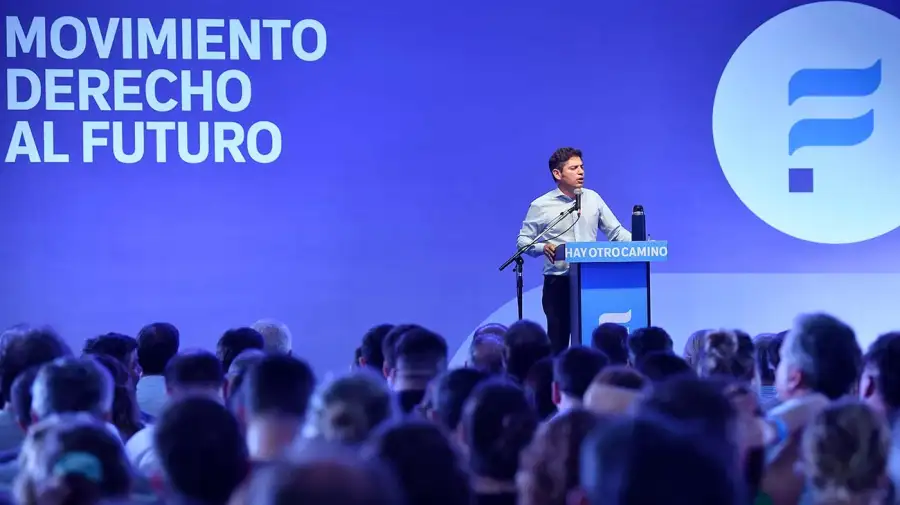
The national launch of Movimiento Derecho al Futuro in Avellaneda, led by Buenos Aires governor Axel Kicillof, accelerated that discussion. Kicillof presented the group as an alternative to the government and later took part in political and institutional activities in the United States. Those moves coincide with the organisation of other opposition groups and with the need to settle alliances, candidacies and decision-making rules without allowing internal disputes to dominate the public message.
A September survey by Proyección Consultores, based on 1,354 cases, entered the debate as a snapshot of rejection. Asked whether they would vote for any option to prevent the rival side from winning, 40.5% answered in relation to stopping Milei's re-election and 35.7% in relation to blocking a Peronist or Kirchnerist victory. The survey records opinions at a specific moment; it is not an electoral forecast and does not replace a comparison of programmes.
Leaders associated with the Left Front argue that an agreement limited to opposing the president would leave the government's economic direction and reforms largely unchallenged. Their priorities include reviewing labour reform, Decree 70/2023, incentives for large investments and changes affecting glacier protection. They also call for higher wages and pensions and stronger funding for universities, public health and disability policies.
Within Peronism, the discussion combines the aim of broadening the coalition with demands to preserve a recognisable programme. Leaders from different currents say unity must include commitments on income, production, employment and social protection. Differences remain over leadership, the relationship between party structures and emerging groups, and how to prevent candidate selection from displacing debate over the policies a future administration would seek to implement.
Máximo Kirchner added a proposed Tax on International Capital Transfers to the agenda. The bill sets a 3% rate on certain capital transfers abroad and an extra 2% when funds go to low- or no-tax jurisdictions. Its sponsors estimated that, if applied to 2025 transactions, it could have raised 2.89 trillion pesos. That is a political and fiscal estimate that Congress would have to examine together with the measure's scope, effects and enforcement mechanisms.
Leaders of the Renewal Front argue that opposition to current policies and the presentation of an alternative are not mutually exclusive. They propose a broad front capable of retaining internal differences while agreeing on priorities and a common basis for competition. The formula still has to define which groups would participate, how representation would be distributed and how shared diagnoses would become verifiable commitments to voters.
The coming months will bring further tours, party congresses and legislative proposals. The immediate challenge is not only to gather leaders under one label, but to establish a sequence of decisions on programme, coalition and candidacies. Until those decisions are formalised, the tension between an identity built through opposition and a platform of its own will remain open across the opposition spectrum.