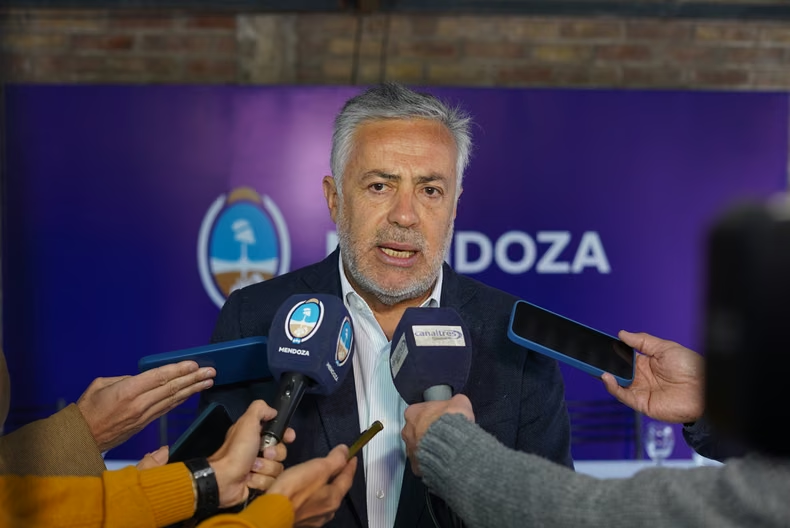
San Rafael's traditional Forces of Production luncheon again brought together political and business power from southern Mendoza, but the 2026 edition was dominated by the electoral race. The Alfredo Bufano Convention Center hosted infrastructure announcements, sectoral demands and a display of leaders already positioning themselves to succeed Governor Alfredo Cornejo or contest the municipal government.
Cornejo closed the event with energy-infrastructure announcements. He reported US$43 million in electricity tenders, highlighted the recovery of Los Nihuiles and again presented the Mendoza Sur solar park as a central element of the province's energy future. He also defended a US$200 million loan in the 2027 budget to finance business conversion and productive capacity.
Silvina Pietrelli, president of the Chamber of Commerce and Industry, shared center stage with the governor. Peronist Mayor Omar Félix, however, chose not to speak. His silence gained political meaning because his brother Emir, a former mayor and national lawmaker, later criticized both Cornejo and the business chamber, extending the historic confrontation between the provincial Radicals and local Peronism.
Businessman Jorge Brito's presence added another layer of speculation. He attended in connection with the solar investment and was the only prominent national figure at the luncheon, one year after Javier Milei filled that role. His name is circulating as a possible electoral actor, although the event produced no formal announcement. His appearance alone placed him on the 2027 board.
The provincial ruling coalition displayed almost all its potential candidates. Tadeo García Zalazar, Ulpiano Suarez and Natalio Mema attended, while Luis Petri cited congressional duties for his absence. Deputy Governor Hebe Casado was more direct: she repeated her intention to succeed Omar Félix as mayor and argued San Rafael needs renewal after twenty-five years under the same political leadership.
Ulpiano Suarez sought to define his relationship with the federal government. He said that even within a provincial alliance with La Libertad Avanza, he would support measures benefiting Mendoza and oppose harmful ones. He also defended PASO primaries for heterogeneous coalitions. García Zalazar emphasized his eight years as a mayor and his ability to build working teams.
Peronism also used the event to send organizational signals. Emir Félix confirmed that PJ mayors, including Matías Stevanato, asked him to remain party leader for two more years. That decision affects provincial candidacies because Stevanato is considered a possible gubernatorial contender and control of the party will be decisive in organizing tickets and alliances.
The luncheon left two overlapping agendas. One is concrete: electricity tenders, infrastructure recovery, a solar park and productive-conversion credit. The other is electoral and still lacks final names. The next step is to see whether the announcements become projects and financing while Radicals, libertarians, business figures and Peronists turn gestures into candidacies. In San Rafael, production and succession are now linked.